
Step 7 — Construct tip_top_nodes via intersection
The top edge of the tip meets two simultaneous conditions: belong to
tip_nodes and to top_nodes.
CMSEL,S,tip_nodes
CMSEL,R,top_nodes
*GET,n_tip_top,NODE,0,COUNT
CM,tip_top_nodes,NODE
ALLSEL,ALL
CMSEL,S retrieves the first component. CMSEL,R intersects it with the
b. The result must be non-empty, less than the full face of the tip and less than all
the top face:
0 < n_tip_top < n_tip
0 < n_tip_top < n_top
Step 8 — Demonstrate that the ends do not overlap
A positive-length beam cannot have nodes belonging to both ends:
CMSEL,S,fixed_nodes
CMSEL,R,tip_nodes
*GET,n_overlap,NODE,0,COUNT
ALLSEL,ALL

*GET,n_restored,NODE,0,COUNT
The expected conditions are:
n_overlap  = 0
n_restored = n_nodes
The first is a physical check. The second is a health check: it confirms that no accidental filters will continue to affect subsequent modules.
Step 9 — Turn regions into an executable contract
A component that exists by name may be empty or contain too much. The deliverable evaluates
all relationships and summarizes the result in passes:
passes=1
*IF,n_fixed,LE,0,THEN
  passes=0
*ENDIF
*IF,n_overlap,NE,0,THEN
  passes=0
*ENDIF
*IF,n_restored,NE,n_nodes,THEN
  passes=0
*ENDIF
Then generate legible evidence:
*CFOPEN,m02_selection_audit,csv
*VWRITE
('case,beam_l,beam_h,mesh_h,n_nodes,n_elements,n_fixed,n_tip,n_top,n_mid_elems,n_tip_top,n_overlap,n_restored,passes')
...
*CFCLOS
Open m02_selection_audit.csv and check that the last column is valid 1.
Exact counts may vary; the relationships recorded in the file
02_expected_results.csv must always be adhered to.
The pattern to keep
Select → count → name → restore → recover → audit
Translated to APDL:
NSEL,S,...
*GET,n_region,NODE,0,COUNT
CM,region_nodes,NODE
ALLSEL,ALL

CMSEL,S,region_nodes
! operation on the region
ALLSEL,ALL
This pattern separates the definition of a region from its use. In M05 we may apply constraints or loads to components whose meaning has already been proven.
Native geometry and Booleans
The KP → LINE → AREA → VOLU hierarchy is associative: a Boolean may rebuild and renumber lower-level entities. Practise primitives and the working plane with 02_geometry_primitives.mac, then build the I section with AOVLAP + VEXT in 02_ipe_profile.mac.
Cut the web with VSBV in 02_ipe_opening.mac, compare the three-volume VOVLAP route in 02_vovlap_variant.mac, and try the VDRAG sweep. AGLUE/VGLUE share topology; NUMMRG,NODE acts only on coincident mesh.
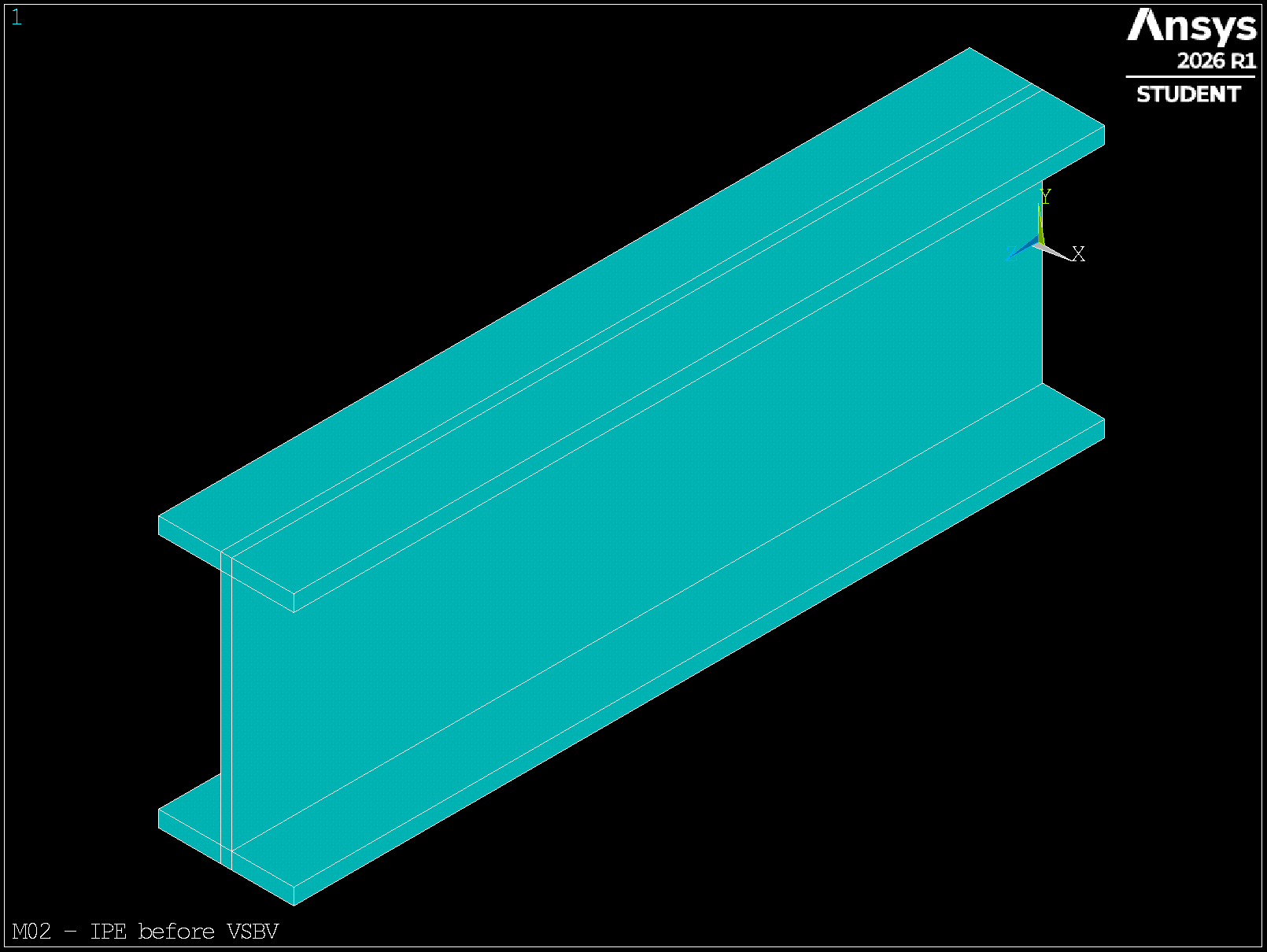
VSBV: one continuous I-section volume.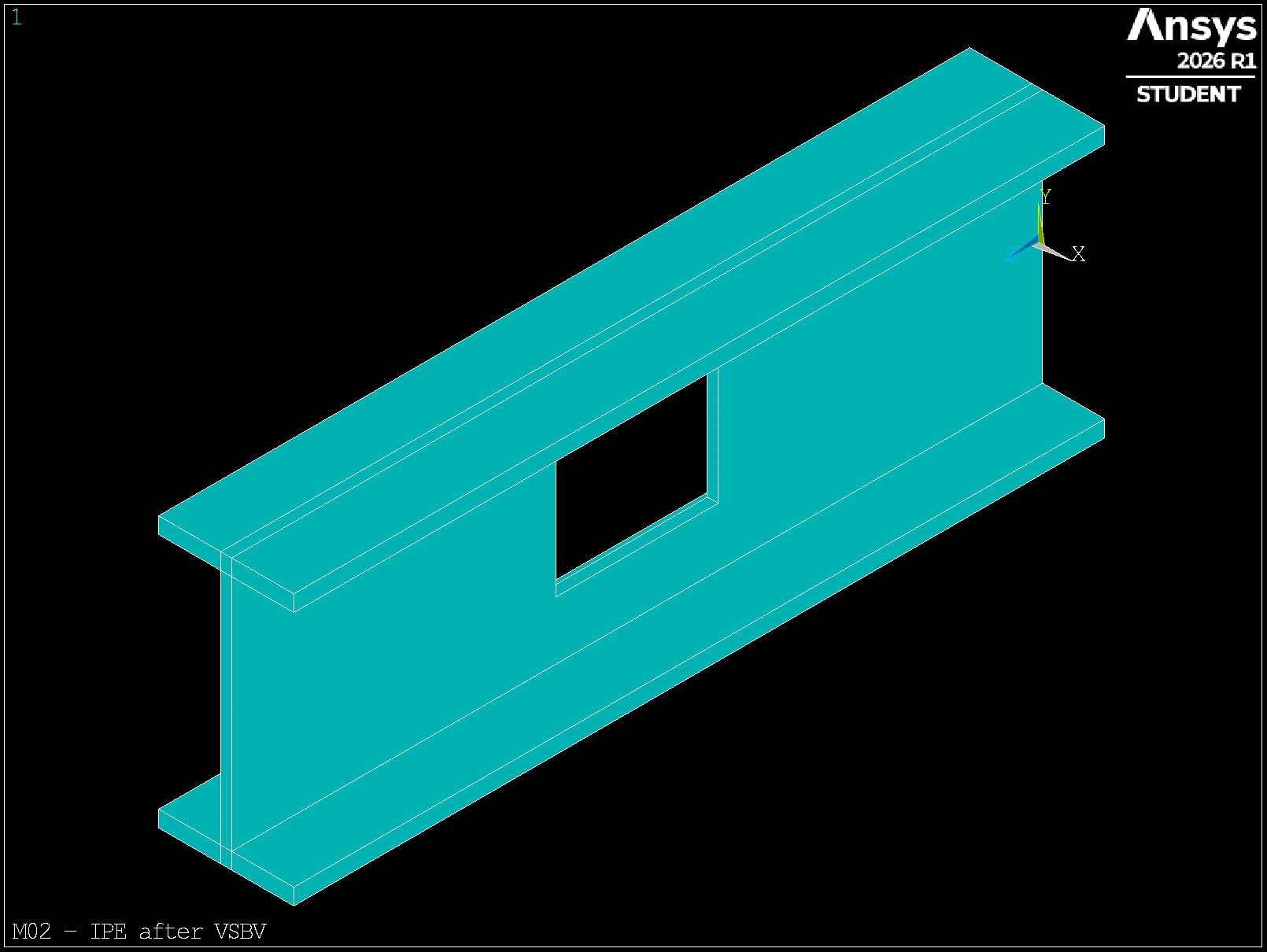
VSBV: a verifiable central opening.*GET to record keypoints, lines, areas, and volumes before/after. Do not use peak stress at a sharp corner as a convergence target.