
Step 1 — Build the parametric geometry
The M01 block remains:
/PREP7
ET,1,SOLID185
MP,EX,1,young
MP,PRXY,1,nu
TYPE,1
MAT,1

BLOCK,0,beam_l,0,beam_h,0,beam_b
ESIZE,mesh_h
VMESH,ALL
A BLOCK isolated creates a volume delimited by six areas, twelve lines and eight
keypoints. VMESH adds elements and nodes. Your IDs may change even though the solid
represent the exact same beam.
M02 limit: We use very ET, MP, ESIZE and
VMESH as legacy infrastructure. The choice of element and material is
will be justified in M03; the meshing strategy will be studied in M04.
Before reducing any selection, we save the full size of the model:
ALLSEL,ALL
*GET,n_nodes,NODE,0,COUNT
*GET,n_elements,ELEM,0,COUNT
These two values are our baseline. At the end they should reappear exactly.
Step 2 — Think of selections as set algebra
The second command argument xSEL indicates how the new condition is combined
with the active set:
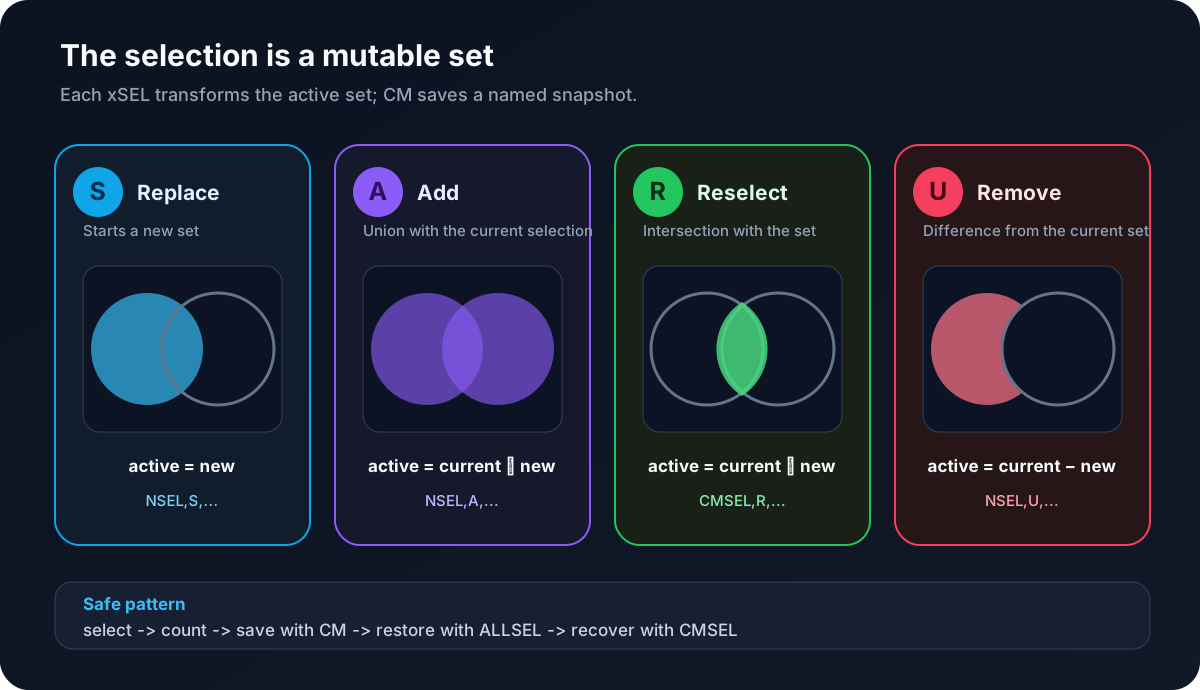
A, R, and U operate on the previous selection state.
| Operation | Reading | Result |
|---|---|---|
S | Select | Replace the active set with a new one. |
A | Additionally select | Add entities: union. |
R | Reselect | Keep the intersection. |
U | Unselect | Withdraw entities: difference. |
That is why a selection sequence must be read from top to bottom. If an operation leaves the set empty, a subsequent reselection cannot retrieve entities that were no longer active.
Step 3 — Control geometric tolerance
A calculated coordinate and a stored coordinate can differ by tiny fractions.
MAPDL uses a tolerance on non-integer value selections. Its automatic logic depends
of VMIN and VMAX; for example, if both are equal and not null, you can take
the 0.5 % requested value
A global selection at X=1.0 m could include a much wider band of the
expected when the mesh is very fine. In a reproducible script it is convenient to declare the criterion:
select_tol=MIN(beam_h,beam_b)*1E-5
SELTOL,select_tol
For the base case, select_tol=5E-7 m. It is small compared to the geometry and sufficient
to absorb numerical noise. Tolerance remains active until redefined, so in the end
we will restore it:
SELTOL,A Tolerance Must Not Equal the Element Size
If you wrote SELTOL,mesh_h, a face selection could also capture the
next node layer. The command would work; the physical region would be incorrect.