
M10 introduced geometric and material nonlinearity. M11 opens the
second optional specialization: structural contact between two 3D bodies.
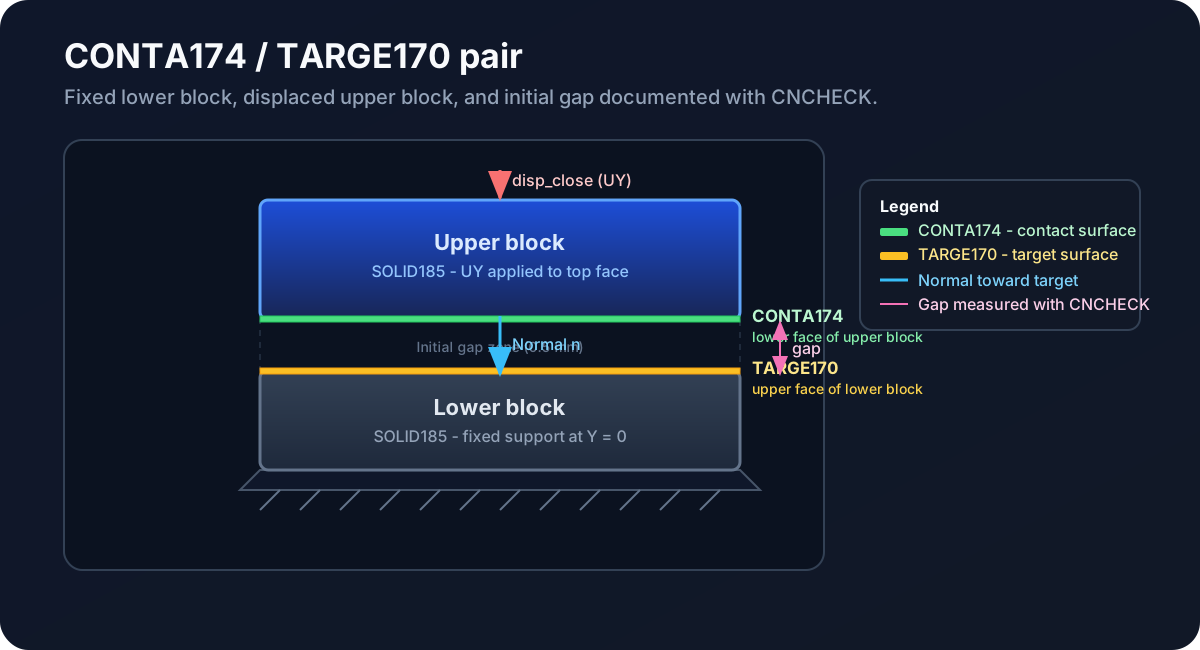
You will define a CONTA174/TARGE170 pair, run
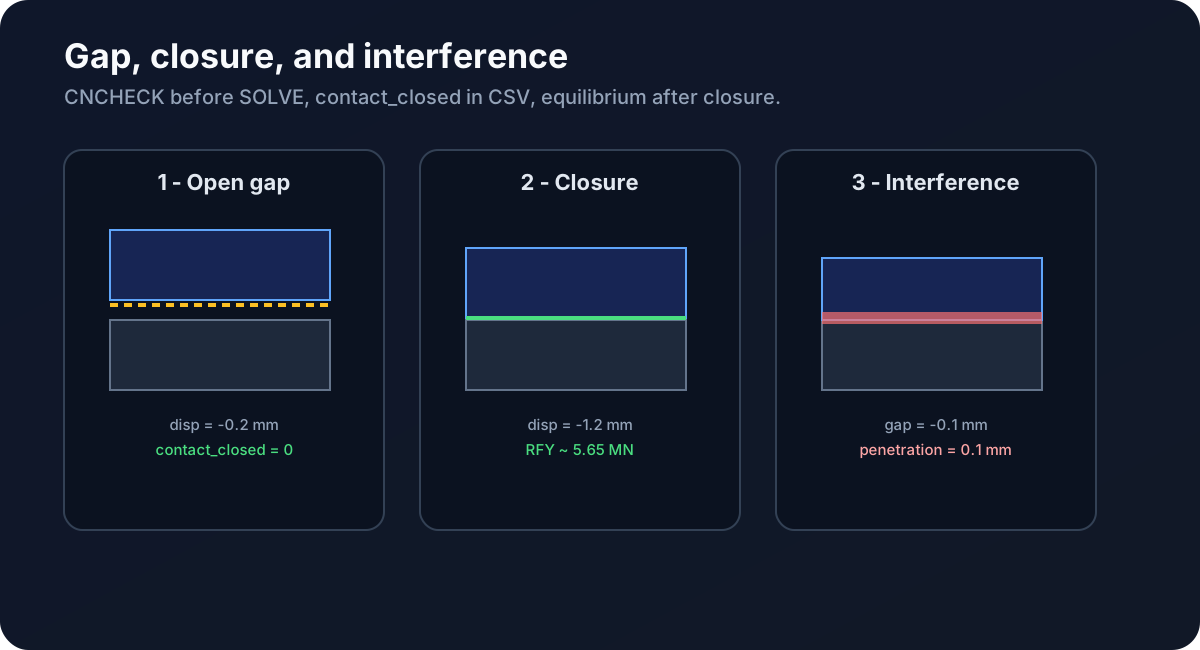
CNCHECK before solving, and document gap, penetration, and closing reaction
with CSV evidence.
Your mission
You will build two stacked blocks, create the contact pair, audit the initial state, close the contact with controlled displacement, and compare three verifiable cases in CSV.
Guiding question: can you prove whether contact is open or closed before trusting the stresses?
Objectives
After completing M11, you will be able to:
- Select surfaces and generate
CONTA174andTARGE170elements withESURF. - Configure a frictionless pair with consistent
REAL,TYPE, andKEYOPTsettings. - Run
CNCHECK,AUTOand document the initial gap or penetration. - Solve with
NLGEOM,ON, ramping (KBC,0,NSUBST), and rigid-body-motion constraints. - Extract support reactions and determine
contact_closedusing a numerical criterion. - Diagnose common faults by reading the
.outfile and audit CSV.
Prerequisites and downloads
- M06: substeps and global equilibrium.
- M10 (recommended):
NLGEOMand nonlinear convergence. - M02: robust surface selection (
ASEL,SELTOL).
11_start.mac— starting point.11_contact_pair.mac— audited deliverable.11_bug_hunt.mac— five faults.11_challenge.mac— verifiable challenge.11_expected_results.csv— numerical contract.contact-pair-setup.svg— contact/target pair.initial-gap-penetration.svg— initial states.
How to use this lesson
| Path | Duration | Coverage |
|---|---|---|
| First win | 20–25 min | Geometry, contact pair, CNCHECK, and first CSV. |
| Complete | 70–75 min | Three cases, POST1, debugging, challenge, and mastery. |
Session map
- Mission: objectives, downloads, and prediction.
- Mental model: contact versus target, normals, and gap.
- Demonstration: geometry, pair,
CNCHECK, and solution. - Debugging: five common faults.
- Challenge: friction or gap variation.
- Mastery: final M11 test.